What a telecaller really costs per minute of talk time in India (2026)
A seat costs about ₹30,000 a month, but a telecaller talks for only three hours a day. Per minute of conversation that is about ₹7, and the number any AI voice agent has to beat.

Ask a collections head what a telecaller costs and you will hear a salary: ₹15,000, ₹18,000, ₹22,000 a month. Ask what a minute of conversation with a borrower costs and most people have never worked it out. That second number is the one that matters, because it is the only one you can compare with an AI voice agent, and it is a lot higher than the salary suggests.
Here is the arithmetic for a typical outbound floor, with every assumption shown so you can swap in your own.
Step 1: What a seat costs per month
Assumptions for a mid-size outbound floor in a tier-1 or tier-2 city, calling loan, insurance or auto leads:
| Cost line | Per seat per month | How we got it |
|---|---|---|
| Gross salary | ₹18,000 | Entry-level telecaller, fixed pay |
| Employer PF and ESI | ₹1,665 | 12% PF on a ₹9,000 basic, 3.25% ESI on gross |
| Incentives | ₹2,000 | Average payout across the floor |
| Seat | ₹5,000 | Rent, power, desk, PC, headset, dialer and CRM licence |
| Supervision and QA | ₹3,300 | One team lead per 15 seats, one QA per 25 |
| Attrition | ₹600 | 50% a year; each replacement costs about ₹14,000 to hire and train |
| Total | ₹30,565 | Telephony left out: you pay it with humans and with AI |
So the ₹18,000 telecaller is really a ₹30,000 seat. That part most finance teams already know.
Step 2: How many minutes of that seat are conversation
This is the part that surprises people. Take a nine-hour shift. An hour goes to lunch and breaks, half an hour to huddles, training and QA feedback. Of the seven and a half hours left, here is a realistic day at 180 dials and a 30% connect rate:
| Activity | Minutes a day |
|---|---|
| Talking: 54 connected calls at about 3 minutes | 162 |
| Ringing out: 126 unanswered dials at about 35 seconds | 73 |
| Wrap-up and disposition: 54 calls at about 90 seconds | 81 |
| Opening the record and dialing: 180 dials at about 20 seconds | 60 |
| System lag, waiting for the next lead, everything else | 74 |
| Logged time | 450 |
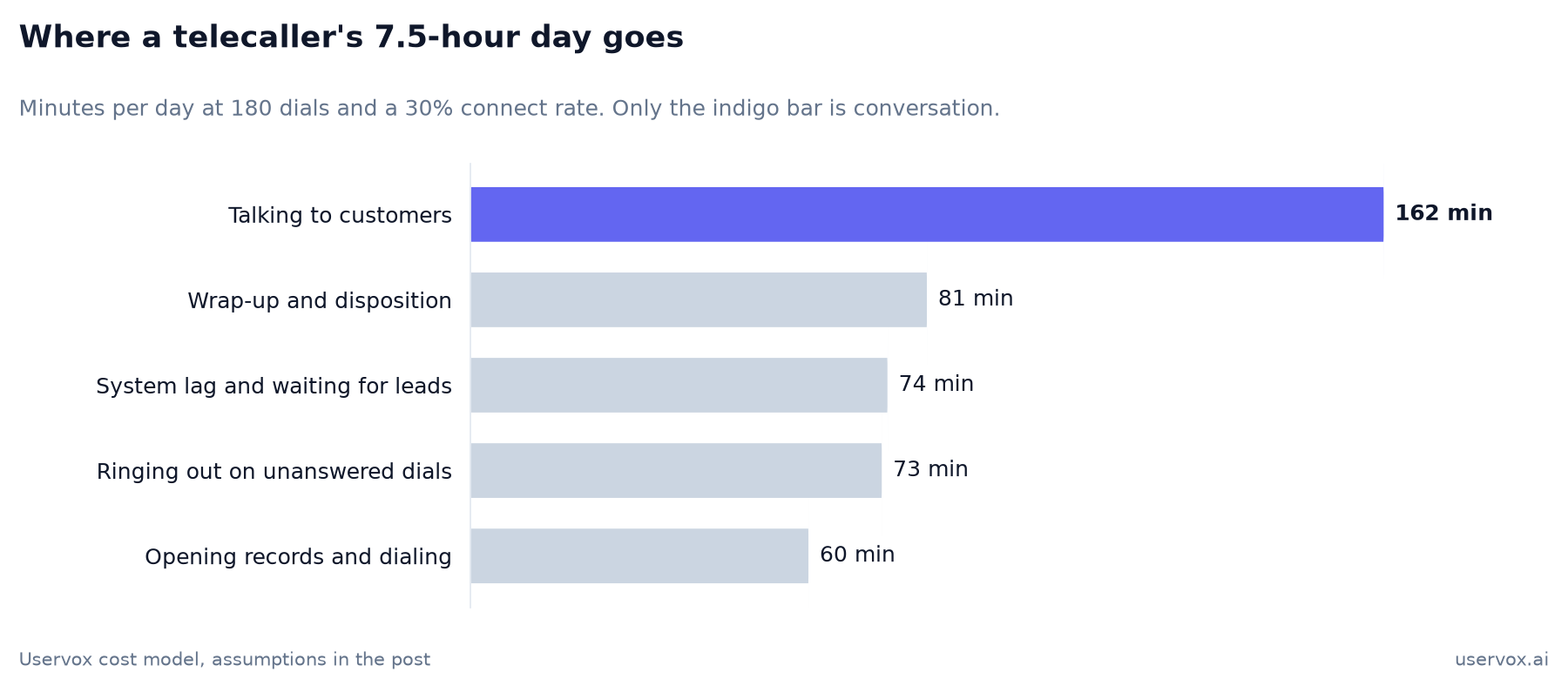
A good telecaller on a good day talks for under three hours. Call it three. Then take out absenteeism: at 10%, 26 working days become about 23.4 days actually on the floor.
23.4 days × 3 hours × 60 minutes = 4,212 minutes of conversation a month.
₹30,565 ÷ 4,212 = ₹7.26 per minute of talk time.
Move the assumptions and the answer stays in a narrow band. A sharp floor with a predictive dialer and four hours of talk time a day gets down to about ₹5. A floor on manual dialing with two and a half hours gets close to ₹9. Most land around ₹7. A three-minute collections conversation therefore costs roughly ₹22 before telephony.
Step 3: The costs that do not show up per minute
Peaks
Calling is never flat. Collections bunch around EMI dates, from a few days before the due date to a few days after. Auto enquiries and service reminders spike through the festive season. A floor sized for the average misses the peak; a floor sized for the peak sits idle the rest of the month.
A lender that needs 60 seats for the first ten days of the month and 25 for the other twenty pays for 60 all month. Only 61% of that capacity is used, which pushes the real cost per talk minute up by about 60%, from ₹7 to over ₹11.
Languages
A borrower in Coimbatore picks up for Tamil, not for Hindi. Covering Tamil, Telugu, Bengali and Marathi properly means hiring for each language, and every one of those small teams has its own peak problem and its own attrition.
Speed to lead
An enquiry called in the first five minutes behaves very differently from one called the next morning. A floor working a queue cannot call every new lead instantly at 9:40 pm or on a Sunday.
What an AI voice agent has to beat
An AI agent does not take breaks, does not wait for the next lead and does not need a huddle. Its ringing and dialing time cost almost nothing, so the honest comparison is cost per connected minute against the human ₹5 to ₹9, and against ₹11 or more once you account for peaks.
For a sense of scale: our agents make 6 to 7 lakh calls a day, and on busy days more than 10 lakh. At 180 dials per telecaller, the same volume would need somewhere between 3,300 and 3,900 people on the floor every day.
When you compare quotes from AI voice vendors, ask six questions:
- Are you billed per connected minute, or per dial? Paying for ringing and unanswered calls can double the effective rate.
- Is telephony included? If not, add it to both sides of your comparison.
- Is there a minimum monthly commitment? That brings the peak problem back.
- Do regional languages cost the same as Hindi and English?
- How fast does it reply? Ask for a live call, not a recording. Pauses of more than a second make people hang up. Ours reply in 200 to 600 ms.
- Where does the outcome go? A promise-to-pay that never reaches your CRM is a wasted call.
Where humans still win
None of this means firing the floor. Hardship cases in late-bucket collections, high-ticket negotiations and relationship sales still need a person. The setups we see working best let the AI agent make every first call, reminder and follow-up, then hand the conversations that need judgement to a smaller, better-paid human team that only talks to people who picked up and need them.
Work out your own number
Put in your own floor's numbers. Add the per-minute rate from any AI voice quote you have, ours or anyone else's, to see the monthly difference. Nothing you type leaves this page.
The formula behind it: cost per talk minute = monthly cost per seat ÷ (working days × (1 − absenteeism) × talk hours × 60 ÷ peak sizing). Talk hours are the one input worth measuring properly. Most dialers report them; if yours does not, sample five telecallers for a week. If the result surprises you, we are happy to walk through it with your numbers.