What Is a DPD Bucket? A Calling Plan for Each Bucket
DPD means days past due. What each DPD bucket means, how it maps to RBI's SMA categories, and what the collection call in each bucket should do, with data from 40,000 loans.
Last updated: 14 October 2026.
DPD stands for days past due: how many days a loan instalment has gone unpaid after its due date. A DPD bucket groups loans by that number, so a collections team can treat a borrower who is two days late differently from one who is two months late. Every lender in India uses buckets, but few write down what the calls in each one are for. This guide does, with numbers from our own calling.
DPD buckets and RBI's SMA categories
RBI's own labels are the Special Mention Account (SMA) categories, set out for all lenders and all loans, retail included, in its circular of 12 November 2021. Lenders' internal bucket names vary (some call the current book "Bucket 0" or "X", some start "Bucket 1" before the due date), so map yours to the DPD ranges below.
| DPD | RBI category | Goal of the call | Tone | Who calls |
|---|---|---|---|---|
| Before due | Standard | Remind the amount and date, send the payment link | Friendly, short | AI agent |
| Due day (DPD 0) | Standard until day end | A same-day nudge to people who have not paid yet | Friendly | AI agent |
| 1-30 | SMA-0 | Get a dated promise to pay, learn why it was missed | Firm and helpful | AI agent, with a person for hardship cases |
| 31-60 | SMA-1 | Reconnect and agree a plan within the lender's policy | Problem-solving | People, with AI for reminders and promise follow-ups |
| 61-90 | SMA-2 | Restructure or settle, prepare notices | Formal | Certified recovery agents |
| 90+ | NPA* | Settlement or legal recovery | Formal | Recovery and legal teams |
*For NBFCs, RBI says the 90-day reference is read "as per the applicable norms" under its Scale Based Regulation framework.
What the numbers say: the outcome is decided in ten days
We looked at about 40,000 loans that one digital lender's borrowers had due in September 2026, all short-tenure personal loans, and followed each one through its buckets. 35% were paid before the due date and 60% by the end of the due day. By DPD 3 it was 71%, by DPD 14 74%, and by DPD 30 only 76%.
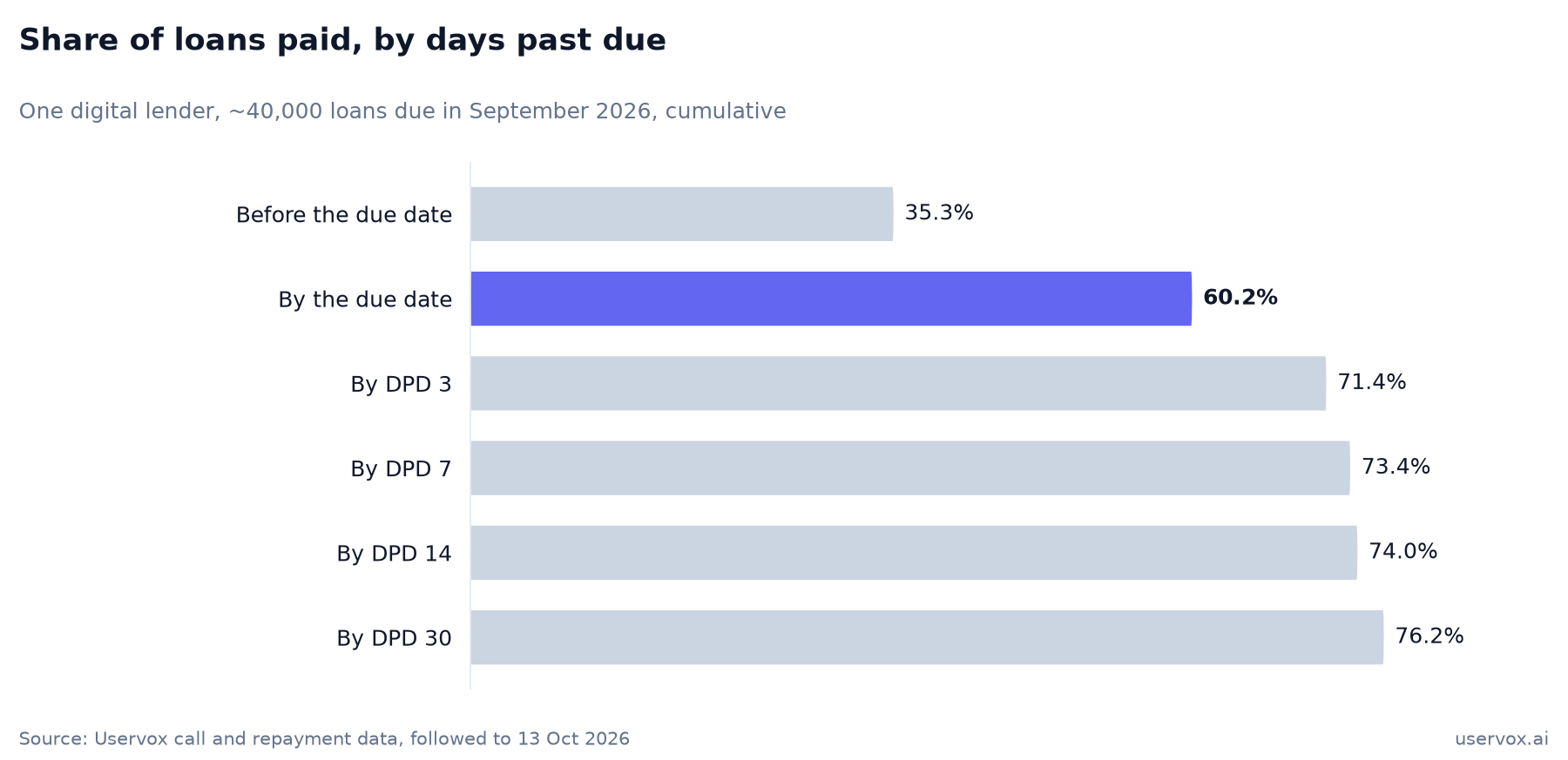
The chance of paying falls off fast once a loan slips. A loan still unpaid at DPD 3 had a 10% chance of being paid by DPD 14. One unpaid at DPD 7 had a 3% chance of being paid by DPD 30, and at DPD 14 it was under 1%.
The calling effort did not follow the money. Loans in the 31-60 and 61+ buckets took 31% of all calls and produced under 1% of the loans closed. It took about 46 calls to close a loan before the due date, 22 on the due day, and 41 in DPD 1-30, against more than 1,200 in DPD 31-60 and nearly 3,900 after DPD 60.
The quality of a promise to pay changed by bucket too. Before the due date, 71% of borrowers who named a date paid by the day after it. In the 31-60 bucket, 6% did.
These are one lender's short-tenure loans, so the exact numbers will differ for a two-wheeler or home loan book. The shape is what matters: most of what will be collected is collected around the due date.
A calling approach for each bucket
Before the due date and on the due day
This is where most of the money is. Remind early (from about seven days out), keep the call under a minute, and always send a payment link afterwards. Borrowers who promise to pay "on the due date" mostly do, so one reminder on the morning of that date is enough. A promise dated after the due date is the first warning sign and should move the loan to the closer follow-up track straight away.
DPD 1-30 (SMA-0)
Most late payers here are short of cash until salary day, not unwilling. Ask what happened, agree a specific date, and follow up on that date. Do not bunch all the attempts into the first week and then go quiet: payments in this bucket cluster around the start of the month, so keep a light cadence through to DPD 30. A borrower who mentions job loss or a medical problem should reach a person who can offer a plan.
DPD 31-60 (SMA-1)
Redialling a number that has never answered is the biggest waste in collections. In our data, unpaid loans that were never reached still got a median of 81 attempts. After about 15 attempts with no conversation, switch to WhatsApp, SMS and email with the payment link, and ask for alternate contact details. Borrowers who do talk and ask for a settlement or a plan are the ones most likely to pay; give them a person who can agree terms.
DPD 61-90 (SMA-2) and NPA
This is human work: restructuring, settlement and formal notices. From 1 January 2027, recovery agents need the IIBF certificate, calls are limited to 8am to 7pm, and every recovery call must be recorded. We covered the changes in our guide to the RBI recovery agent guidelines. Service and collection calls from NBFCs must also come from 1600-series numbers, as explained in our post on 140 and 1600 numbers.
Where AI fits and where it does not
AI agents do well on the high-volume, scripted calls: pre-due reminders, due-day nudges, promise follow-ups and early-bucket calls, in the borrower's own language. They should hand a call to a person when it turns to hardship, a dispute, a death in the family, or a request for a settlement only the lender can approve. In the later buckets the work is negotiation, and people are better at it.
Hear an AI collections call for yourself: the demo calls your phone in about a minute.
Sources
- Reserve Bank of India, RBI/2021-2022/125, 12 November 2021: Prudential norms on Income Recognition, Asset Classification and Provisioning pertaining to Advances, Clarifications (SMA and NPA classification).
- Uservox call and repayment data: one digital lender's loans due 1-30 September 2026 (about 40,000 loans), followed to 13 October 2026. "Paid" means the lender's own loan status showed the loan closed.