Refusal Is Not Default: What Borrowers Say on Collection Calls
Two in three borrowers who refused or got angry on a collection call still paid. What borrowers say on collection calls, what each answer tells you, and how to respond.

Last updated: 16 October 2026.
"Main nahi bharunga." "Phone mat karo." Every collections agent hears these lines every day, and most floors mark these borrowers as the hard cases. Our data says that is often the wrong call. Among about 40,000 loans that one digital lender had due in September 2026, two in three borrowers who refused, got angry or asked not to be called still paid, most of them within three days of the due date. This post looks at what borrowers actually say on collection calls, and what each kind of answer tells you.
What borrowers said, and who paid
We grouped every loan by the strongest thing the borrower said on any connected call before DPD 14, then checked whether the loan had been paid by 13 October, when every loan was at least 14 days past its due date.
| What the borrower said | Share of loans | Paid by 13 October |
|---|---|---|
| Gave a dated promise to pay | 12% | 90% |
| Gave a vague commitment ("kar dunga") | 3% | 88% |
| Talked, but committed to nothing | 29% | 74% |
| Never reached on any call | 44% | 72% |
| Explained a hardship (salary delay, illness, job loss) | 9% | 68% |
| Refused, got angry or asked not to be called | 4% | 65% |
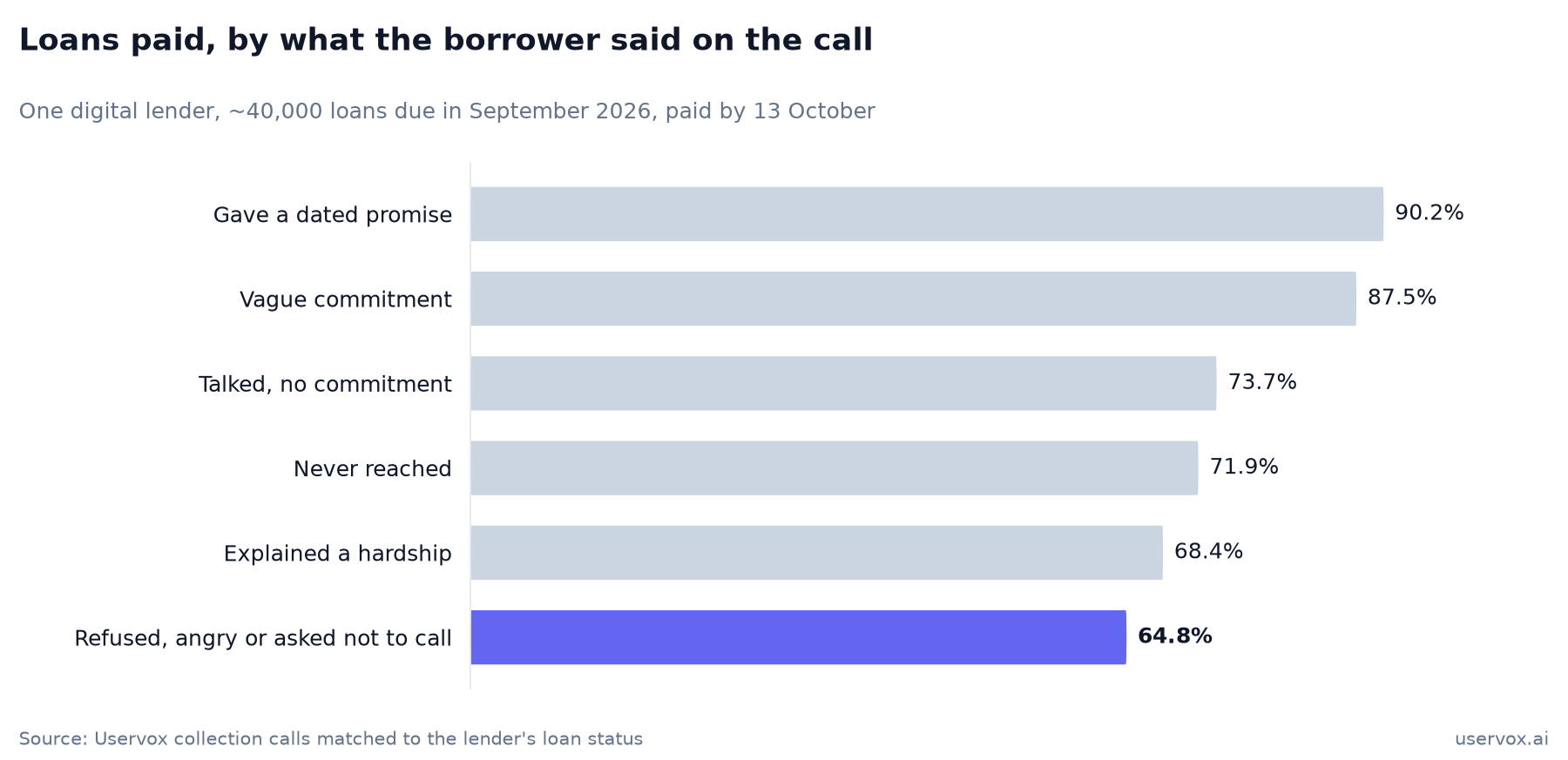
The gaps between the groups are smaller than most teams expect. A refusal on the phone is mostly a bad moment, not a decision. Of the refusers who paid, nine in ten paid by DPD 3.
After DPD 14, talking matters more than what was said
Once a loan is two weeks late, the picture changes. Borrowers who had explained a hardship before DPD 14 were three to four times as likely to repay afterwards as the average late borrower, and those who had given a dated promise two to three times as likely. Even borrowers who had refused repaid more often than those who had never spoken to anyone. The borrower to worry about is the one who has said nothing at all: borrowers never reached made up 48% of loans still unpaid at DPD 14.
What each answer tells you, and how to respond
"Nahi bharunga" or anger
Usually frustration about the call, the charges or the timing. Stay calm, do not argue, state the amount and the due date accurately, and ask one question: "Aap kab tak kar paayenge?" Note any request not to be called, and keep to your calling rules. Do not escalate the tone; the data says most of these borrowers will pay within days.
Hardship
The most valuable conversation in collections. These borrowers want to pay and are telling you why they cannot yet. Offer what the lender's policy allows (a date after salary, a part-payment, a plan) and hand the call to a person who can agree terms. Borrowers who asked for a settlement, a waiver or an EMI split repaid about 1.7 times as often as the average late borrower who spoke to us.
"Maine bhar diya" (I have already paid)
About half of the late borrowers who said this really had paid, through a channel the calling team could not see. Ask for the UTR or a screenshot, send it to the lender to reconcile, and pause calls until it is checked. Calling someone who has paid is the fastest way to a complaint.
Silence
No answer, ever. These borrowers were mostly unreachable before they missed a payment, so redialling the same number rarely works. Switch early to WhatsApp, SMS and email with the payment link, and ask the lender for alternate contact details. Start this from DPD 1 for anyone you could not reach before the due date.
Bereavement or serious illness
Stop calling and pass the case to the lender's operations team. No collection target is worth the harm, or the complaint.
Where AI agents help
An AI agent hears every word of every call and can tag what the borrower said in the same way each time: promise, vague commitment, hardship, refusal, "already paid". That turns a day of calls into a sorted list for the team: who needs a reminder, who needs a person, who needs a pause. It also keeps its tone on the worst calls. What it should not do is negotiate terms it cannot approve; those calls belong with a person.
Hear how an AI agent handles a collection call: the demo calls your phone in about a minute.
About the data
- About 40,000 short-tenure personal loans due 1-30 September 2026 at one digital lender (not named), with every Uservox collection call on them from seven days before the due date. "Paid" means the lender's own loan status showed the loan closed.
- Each loan is counted once, under the strongest signal on any connected call: refusal, then hardship, then a dated promise, then a vague commitment, then a connection with no commitment.
- This shows how borrowers behaved, not what the calls caused. Exact rates will differ for other loan types.